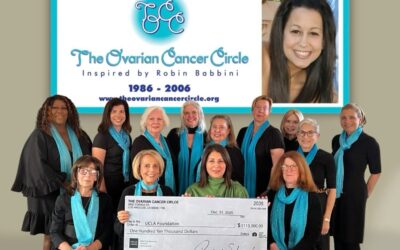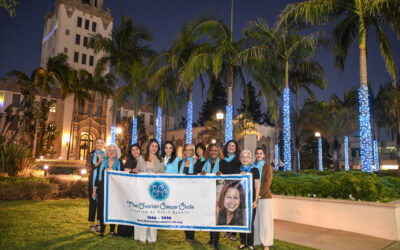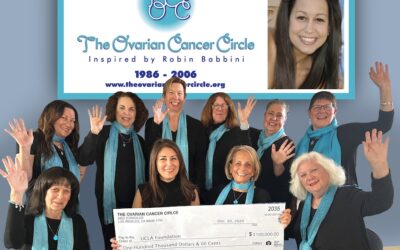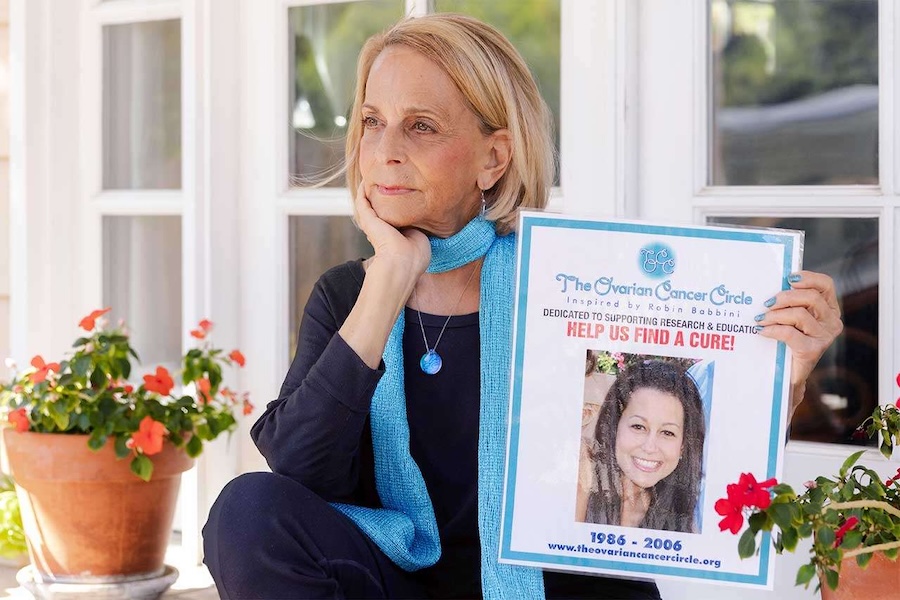
Caption: Following the death of her daughter, Robin, from ovarian cancer at age 20, Paulinda Schimmel Babbini turned her grief into action to found The Ovarian Cancer Circle/Inspired by Robin Babbini.
This July, UCLA Health’s U Magazine tells the story of Paulinda Schimmel Babbini’s drive to start The Ovarian Cancer Cirlce/Inspired by Robin Babbini, following the loss of her daughter at the age of 20 to the deadly disease.
The article (excerpts below) highlight Paulinda’s critical cause:
Babbini has made it her mission to educate women and girls of all ages about ovarian cancer, which is among the leading causes of cancer-related death among women, according to the American Cancer Society. “People just don’t know enough about this cancer,” she says, “especially because its symptoms are so elusive.”
In the four years after Robin’s death, Babbini slowly emerged from her mourning to take a huge step outside of her comfort zone. Describing herself as a private woman unaccustomed to public speaking, Babbini, with the help of a small group of volunteers, launched her nonprofit, The Ovarian Cancer Circle/Inspired by Robin Babbini, in 2010. Since its inception, The Circle, as many know it, has raised and donated more than $1 million to support gynecologic oncology research at UCLA Health.
“Either I could have crawled into a cave and become the most depressed person imaginable, or I could take a new path and move beyond my loss, turning grief into something positive and productive,” says Babbini. “The Circle is a vigorous, positive outlet to do good. It has saved me, and it will, I hope, save many, many lives.”
A powerful partnership
In the earliest days of the Ovarian Cancer Circle, Babbini was introduced to Sanaz Memarzadeh, MD (RES ’00, FEL ’03), PhD ’08, a gynecologic oncologist and researcher at UCLA Health. Babbini was impressed by a presentation Dr. Memarzadeh made during a conference, and she knew at that moment that she wanted to support her work.
For Dr. Memarzadeh, The Circle’s support transcends its annual donations. A 2020 study found that funding for ovarian cancer research is about 5% of the amount allocated for prostate cancer, though ovarian cancer is far more deadly. Researchers concluded that national funding for ovarian cancer research doesn’t correspond with the lethality of the disease.
“For underfunded diseases like gynecologic cancers, philanthropic support is essential,” Dr. Memarzadeh says. It allows her lab to conduct experiments with few restrictions, exploring novel, breakthrough ideas and generating preliminary data that can lead to subsequent support from larger agencies such as the National Institutes of Health.
Expanding the circle: increasing awareness and support
But funding is only part of the partnership between the physician-scientist and The Circle. “Paulinda has created a community of women who are passionate about women’s-cancer research,” Dr. Memarzadeh says. “Some are survivors themselves; some are in treatment; some have lost loved ones to this cancer. The Circle has become an invaluable communications resource, tethering our research goals to increased public awareness.”
Every year since she founded the Circle, Babbini visits UC Santa Barbara to speak to the current members of Robin’s sorority. Babbini also lobbies year-round with city officials to increase visibility of Ovarian Cancer Awareness Month, along with hosting annual fundraisers, walk/runs, and informative presentations to raise awareness and much-needed support.
It is estimated that ovarian cancer will take the lives of some 13,000 women in the United States in 2025. Babbini wants to save as many of those lives as she can. “The more women who learn about the symptoms, the more proactive they can be,” she says. “I often think that if I had known then what I know now, Robin would be here today.”
To learn more about Paulinda’s and The Circle efforts, read the full article at UCLA Health News.
This article has been shared courtesy of UCLA’s G.O. Discovery Lab. We extend our sincere thanks to UCLA Health News & Insights and author Sandy Cohen for helping share and amplify The Circle’s mission.
For more information, visit The Circle website and learn how to Get Involved.